沙海林 | 避虚就实:中国强金融的理念与道路(中英文)
发布时间:2025-12-05

沙海林
上海市公共关系协会会长。历任上海市委常委、上海市委统战部部长,上海市人大常委会副主任、党组副书记,上海市商务委主任,上海市人民对外友好协会会长。
Sha Hailin
Chairman of Shanghai Public Relations Association/ Former Member of the Standing Committee of the CPC Shanghai Municipal Committee and Minister of its United Front Work Department, Vice Chairman and Deputy Party Secretary of Standing Committee of Shanghai Municipal People's Congress, Director of Shanghai Municipal Commission of Commerce, and President of the Shanghai People's Association for Friendship with Foreign Countries
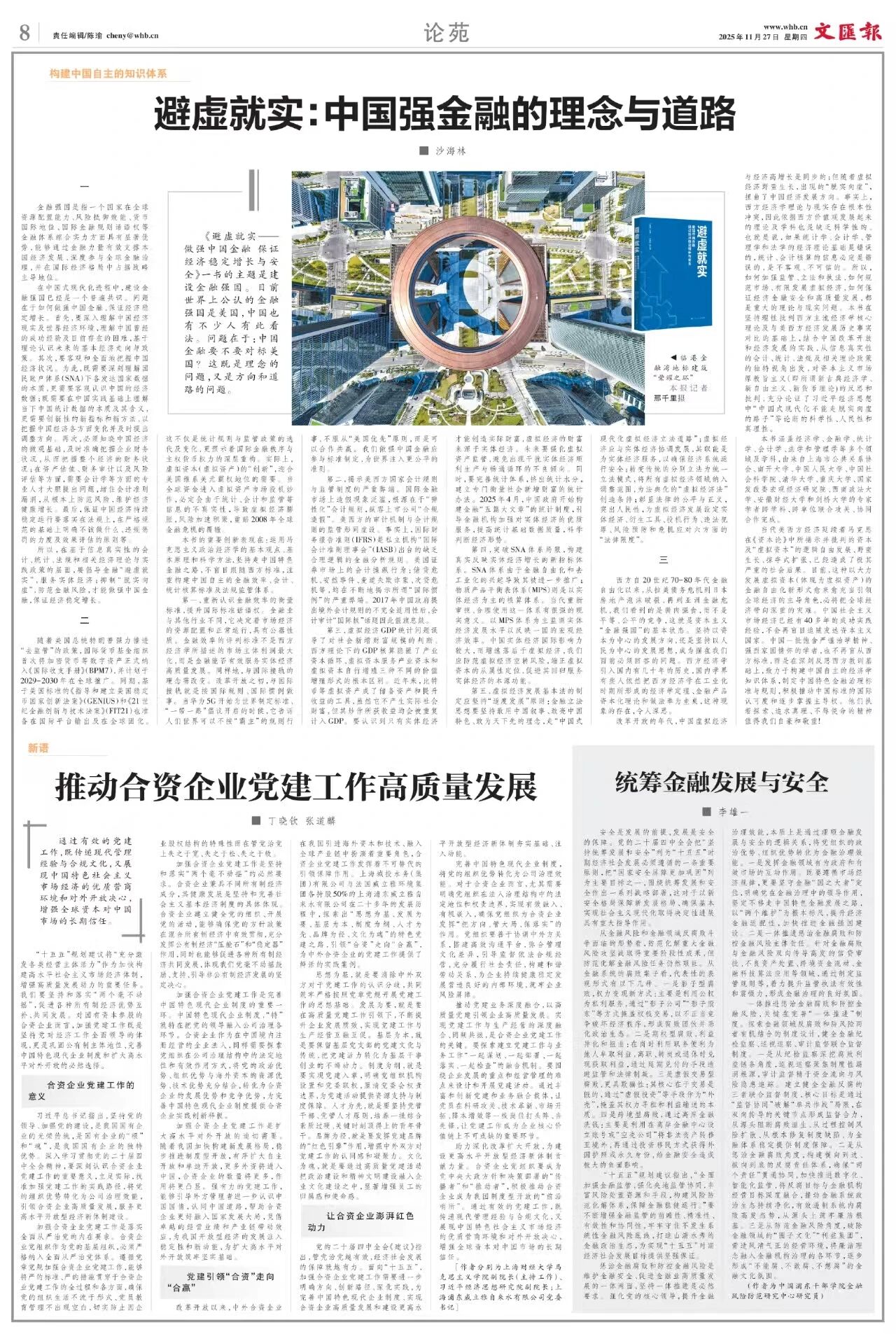

临港金融湾地标建筑“荣耀之环”
本报记者邢千里摄
"Ring of Glory"
——Landmark Building of Lingang Financial Bay
Photo by Xing Qianli, Reporter of This Newspaper
■ 沙海林 (Sha Hailin)
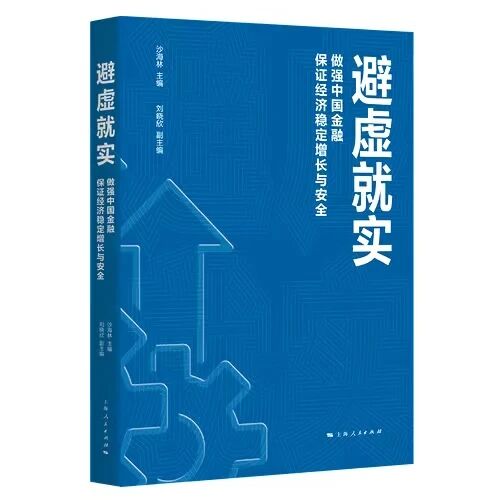
《避虚就实——做强中国金融 保证经济稳定增长与安全》一书的主题是建设金融强国。目前世界上公认的金融强国是美国,中国也有不少人有此看法。问题在于:中国金融要不要对标美国?这既是理念的问题,又是方向和道路的问题。
The theme of the book From Virtual to Real: Strengthening China's Finance to Ensure Stable Economic Growth and Security is building a financial power. Currently, the United States is universally recognized as a financial power worldwide, and many in China hold this view. The question is: Should China's finance benchmark against that of the United States? This is not only a matter of idea but also a question of direction and path.
一
金融强国是指一个国家在全球资源配置能力、风险抵御效能、货币国际地位、国际金融规则话语权等金融体系综合实力方面具有显著优势,能够通过金融力量有效支撑本国经济发展、深度参与全球金融治理,并在国际经济格局中占据战略主导地位。
A financial power refers to a country that holds significant advantages in the comprehensive strength of its financial system, including global resource allocation capacity, risk resistance effectiveness, the international status of its currency, and the right to speak in international financial rules. It can effectively support its own economic development through financial strength, deeply participate in global financial governance, and occupy a strategically dominant position in the international economic structure.
在中国式现代化进程中,建设金融强国已经是一个普遍共识。问题在于如何做强中国金融、保证经济稳定增长。首先,要深入理解中国经济现实及世界经济环境,理解中国曾经的成功经验及目前存在的困难,基于理论认识未来的基本经济走向与政策。其次,要客观和全面地把握中国经济状况。为此,既需要深刻理解国民账户体系(SNA)下各发达国家数据的本质,更需要客观认识中国的经济数据;既需要在中国实践基础上理解当下中国统计数据的本质及其含义,更需要创新性的新指标和新方法,以把握中国经济各方面变化并及时提出调整方向。再次,必须知晓中国经济的微观基础,及时准确把握企业财务状况,从而把握整个经济的财务状况;在资产估值、财务审计以及风险评估等方面,需要会计学等方面的专业人才大胆提出问题,堵住会计准则漏洞,从根本上防范风险,维护经济健康增长。最后,保证中国经济持续稳定运行要落实在法规上,在严格规范的基础上明确不该做什么、违规惩罚的力度及效果评估的原则等。
In the process of Chinese-style modernization, building a financial power has become a broad consensus. The key question lies in how to strengthen China's finance and ensure stable economic growth. Firstly, it is essential to gain an in-depth understanding of China's economic reality and the global economic environment, learn from China's past successful experience and current challenges, and predict the basic future economic trends and policies based on theoretical insights. Secondly, China's economic situation should be grasped in an objective and comprehensive manner. To this end, it is not only necessary to deeply understand the essence of economic data from developed countries under the System of National Accounts (SNA) but also to objectively recognize China's own economic data; it is crucial to comprehend the nature and implications of China's current statistical data based on domestic practices, and more importantly, to develop innovative new indicators and methodologies to capture changes in various aspects of China's economy and promptly propose adjustment directions. Thirdly, it should be understood that the micro-foundation of China's economy and accurately grasp the financial status of enterprises in a timely manner, thereby gaining insight into the overall economic financial situation. In areas such as asset valuation, financial auditing, and risk assessment, professional talents in accounting and related fields should bravely raise questions, address loopholes in accounting standards, fundamentally prevent risks, and safeguard healthy economic growth. Finally, ensuring the sustained and stable operation of China's economy must be anchored in laws and regulations. On the basis of strict standardization, it is necessary to clarify prohibited activities, the intensity of penalties for violations, and the principles for effectiveness evaluation.
所以,在基于信息真实性的会计、统计、法规和相关经济理论与实践政策的层面,要倡导金融“避虚就实”,服务实体经济;抑制“脱实向虚”,防范金融风险,才能做强中国金融,保证经济稳定增长。
Therefore, at the levels of accounting, statistics, laws and regulations, and relevant economic theories and practical policies grounded in information authenticity, it is imperative to advocate for finance to "move from virtual to real" in service of the real economy; curb "shifting from real to virtual" and guard against financial risks, which can strengthen China's finance and ensure stable economic growth.
二
随着美国总统特朗普强力推进“去监管”的政策,国际货币基金组织首次将加密货币等数字资产正式纳入《国际收支手册》(BPM7),并计划于2029-2030年在全球推广。同期,基于美国标准的《指导和建立美国稳定币国家创新法案》(GENIUS)和《21世纪金融创新与技术法案》(FIT21)也准备在国际平台输出及在全球固化。这不仅是统计规则与监管政策的迭代及变化,更预示着国际金融秩序与主权货币权力的深层重构。实际上,虚拟资本(虚拟资产)的“创新”,迎合美国维系美元霸权地位的需要。当全球资金进入虚拟资产市场投机炒作,必定会由于统计、会计和监管等信息的不真实性,导致虚拟经济膨胀,风险加速积聚,重蹈2008年全球金融危机的覆辙。
As U.S. President Donald Trump vigorously advanced his "deregulation" policies, the International Monetary Fund (IMF) officially incorporated digital assets such as cryptocurrencies into the Balance of Payments and International Investment Position Manual (BPM7) for the first time, with plans for global rollout between 2029 and 2030. During the same period, the U.S.-standard-based Guiding and Establishing a United States Stablecoin National Innovation Act (GENIUS) and Financial Innovation and Technology for the 21st Century Act (FIT21) are also being prepared for export on international platforms and solidification globally. This is not only the iteration and transformation of statistical rules and regulatory policies but also indicates a profound restructuring of the international financial order and sovereign monetary power. In fact, the "innovation" of virtual capital (virtual assets) caters to the United States' need to maintain the U.S. dollar's hegemony. When global capital flows into the virtual asset market for speculative activities, the lack of authenticity in statistics, accounting, supervision, and other information will inevitably lead to the expansion of the virtual economy, accelerated risk accumulation, and a repetition of the 2008 global financial crisis.
本书的重要创新表现在:运用马克思主义政治经济学的基本观点、基本原理和科学方法,坚持走中国特色金融之路,不盲目跟随西方标准,注重构建中国自主的金融效率、会计、统计核算标准及法规监管体系。
A key innovation of this book lies in: applying the basic viewpoints, fundamental principles and scientific methods of Marxist political economy, adhering to the path of finance with Chinese characteristics, refraining from blindly following Western standards, and focusing on constructing China's independent systems of financial efficiency, accounting, statistical accounting standards as well as regulatory frameworks.
第一,重新认识金融效率的衡量标准,提升国际标准话语权。金融业与其他行业不同,它决定着市场经济的资源配置和正常运行,具有公器性质。金融效率的评判标准不是西方经济学所描述的市场主体利润最大化,而是金融能否有效服务实体经济高质量发展。同样地,与国际接轨的理念需改变。改革开放之初,与国际接轨就是按国际规则、国际惯例做事。当华为5G开始为世界制定标准、“一带一路”倡议开启的时候,它告诉人们世界可以不按“霸主”的规则行事,不服从“美国优先”原则,而是可以合作共赢。我们做强中国金融应参与标准制定,为世界注入更公平的准则。
First, redefine the measurement criteria for financial efficiency and enhance discourse power in international standards. Unlike other industries, the financial sector determines the resource allocation and normal operation of the market economy, and bears the nature of a public good. The criterion for evaluating financial efficiency is not the profit maximization of market entities as described in Western economics, but whether finance can effectively serve the high-quality development of the real economy. Similarly, the concept of aligning with international standards needs to be transformed. At the beginning of the reform and opening-up, aligning with international standards meant acting in accordance with international rules and practices. When Huawei's 5G began setting standards for the world and the Belt and Road Initiative was launched, it demonstrated that the world can operate without adhering to the rules of "hegemonies" or the "America First" principle, but rather pursue win-win cooperation. To strengthen China's finance, we should participate in standard-setting and inject fairer norms into the world.
第二,揭示美西方国家会计规则与监管制度的严重弊端。国际金融市场上造假现象泛滥,根源在于“弹性化”会计规则,纵容上市公司“合规造假”。美西方的审计机制与会计规则的监管形同虚设。事实上,国际财务报告准则(IFRS)是私立机构“国际会计准则理事会”(IASB)出台的缺乏合理逻辑的金融分析规则。美国证券市场上的会计操纵行为:储贷危机、安然事件、麦道夫欺诈案、次贷危机等,均在不断地揭示所谓“国际惯例”的严重弊端。2017年中国政府提出境外会计规则的不完全适用性后,会计审计“国际板”话题因此偃旗息鼓。
Second, expose the serious flaws in the accounting rules and regulatory systems of the United States and Western countries. The prevalence of fraud in international financial markets stems from "flexible" accounting rules that condone "compliant fraud" by listed companies. The audit mechanisms and accounting rule supervision in the U.S. and the West are merely nominal. In fact, the International Financial Reporting Standards (IFRS) are illogical financial analysis rules issued by the International Accounting Standards Board (IASB), a private institution. Accounting manipulations in the U.S. securities market—such as the Savings and Loan Crisis, the Enron scandal, the Madoff fraud, and the subprime mortgage crisis—have continuously revealed the severe drawbacks of the so-called "international practices." After the Chinese government pointed out the incomplete applicability of overseas accounting rules in 2017, the discussion on the "international board" for accounting and auditing faded away.
第三,虚拟经济GDP统计问题误导了对社会新增财富规模的判断。西方理论下的GDP核算隐匿了产业资本循环、虚拟资本服务产业资本和虚拟资本自行增殖三种不同的价值增殖形式的根本区别。近年来,比特币等虚拟资产成了储备资产和提升收益的工具,虽然它不产生实际社会财富,但其炒作所获收益均会被重复计入GDP。要认识到只有实体经济才能创造实际财富,虚拟经济的财富来源于实体经济。未来要强化虚拟资产监管,避免出现干扰实体经济顺利生产与畅通循环的不良倾向。同时,要完善统计体系,挤出统计水分,建立专门衡量社会新增财富的统计办法。2025年4月,中国政府开始构建金融“五篇大文章”的统计制度,引导金融机构加强对实体经济的优质服务,提高统计基础数据质量,科学判断经济形势。
Third, issues with GDP statistics for the virtual economy have misled judgments on the scale of newly added social wealth. GDP accounting under Western theories obscures the fundamental differences between three distinct forms of value appreciation: the circulation of industrial capital, virtual capital serving industrial capital, and the self-appreciation of virtual capital. In recent years, virtual assets such as Bitcoin have become tools for reserve assets and yield enhancement. Although they do not generate actual social wealth, the profits from their speculation are repeatedly included in GDP. It is crucial to recognize that only the real economy can create actual wealth, and the wealth of the virtual economy originates from the real economy. In the future, we need to strengthen the supervision of virtual assets to avoid adverse tendencies that disrupt the smooth production and circulation of the real economy. Meanwhile, we should improve the statistical system, eliminate statistical inflation, and establish a dedicated statistical method for measuring newly added social wealth. In April 2025, the Chinese government launched the construction of a statistical system for the "Five Major Tasks" in finance, guiding financial institutions to enhance high-quality services for the real economy, improve the quality of basic statistical data, and scientifically assess economic trends.
第四,突破SNA体系局限,构建真实反映实体经济增长的新指标体系。SNA体系由于金融自由化和去工业化的兴起导致其被进一步推广;物质产品平衡表体系(MPS)则是以实体经济为主的核算体系。当代重新审视、合理使用这一体系有很强的现实意义。以MPS体系为主监测实体经济发展水平以反映一国的宏观经济效率。中国实体经济国际影响力较大,而增速落后于虚拟经济,我们应防范虚拟经济空转风险,端正虚拟资本的从属性定位,促进其回归服务实体经济的本源功能。
Fourth, break through the limitations of the SNA system and establish a new indicator framework that truly reflects the growth of the real economy. The SNA system has been further promoted amid the rise of financial liberalization and deindustrialization; the Material Product Balance System (MPS) is an accounting system centered on the real economy. Re-examining and rationally applying this system in contemporary times holds significant practical relevance. The MPS system to monitor the development level of the real economy is used to reflect a country's macroeconomic efficiency. China's real economy wields considerable international influence, yet its growth rate lags behind that of the virtual economy. We must guard against the risk of idle virtual economy operations, rectify the subordinate positioning of virtual capital, and promote its return to the fundamental function of serving the real economy.
第五,虚拟经济发展基本法的制定应坚持“适度发展”原则:金融立法思想要坚持敢用中国叙事、敢亮中国特色、敢为天下先的理念,走“中国式现代化虚拟经济立法道路”;虚拟经济应与实体经济协调发展,其职能是为实体经济服务,以确保经济系统运行安全;转变传统的分别立法为统一立法模式,将所有虚拟经济领域纳入调整范围,为法典化的“虚拟经济法”创造条件;彰显法律的公平与正义,突出人民性,为虚拟经济发展设定实体经济、衍生工具、投机行为、违法犯罪、风险预防和危机应对六方面的“法律限度”。
Fifth, the formulation of the Basic Law on the Development of the Virtual Economy should adhere to the principle of "moderate development": The legislative philosophy for finance must uphold the courage to adopt Chinese narratives, highlight Chinese characteristics, and pioneer new paths, following the "road of legislation on the virtual economy under Chinese-style modernization"; the virtual economy should develop in coordination with the real economy, with its core function being to serve the real economy to ensure the safe operation of the economic system; transform the traditional separate legislative model into a unified one, bringing all virtual economy sectors under regulatory scope to lay the foundation for a codified "Virtual Economy Law"; uphold the fairness and justice of the law, emphasize its people-centered nature, and set "legal boundaries" for the development of the virtual economy in six aspects: the real economy, derivative instruments, speculative activities, illegal and criminal acts, risk prevention, and crisis response.
三
西方自20世纪70-80年代金融自由化以来,从拉美债务危机到日本房地产泡沫破裂,再到亚洲金融危机,我们看到的是弱肉强食,而不是平等、公平的竞争,这就是资本主义“金融强国”的基本状态。坚持以资本为中心的发展方向,还是坚持以人民为中心的发展思想,成为摆在我们面前必须回答的问题。西方经济学引入国内有几十年的历史,国内学界有些人依然把西方经济学在工业化时期所形成的经济学定理、金融产品资本化理论和做法奉为圭桌,这种现象的存在,令人深思。
Since the advent of financial liberalization in the West in the 1970s and 1980s, from the Latin American debt crisis to the burst of Japan's real estate bubble and then the Asian financial crisis, what we have witnessed is the law of the jungle rather than equal and fair competition—and this is the fundamental state of a capitalist "financial power." Whether to adhere to a capital-centered development direction or a people-centered development philosophy has become an unavoidable question we must answer. Western economics has been introduced into China for several decades, yet some scholars in the country still regard the economic theorems, theories and practices of financial product capitalization formed by Western economics during the industrialization period as sacred dogma. The existence of this phenomenon is food for thought.
改革开放的年代,中国虚拟经济与经济高增长是同步的;但随着虚拟经济野蛮生长,出现的“脱实向虚”,扭曲了中国经济发展方向。事实上,西方经济学理论与现实存在根本性冲突,因此依据西方价值观发展起来的理论及学科也是缺乏科学性的。也就是说,如果统计学、会计学、管理学和法学的经济理论基础是错误的,统计、会计核算的信息必定是错误的,是不客观、不可信的。所以,如何加强监管、立法和执法,如何规范市场、有限发展虚拟经济,如何保证经济金融安全和高质量发展,都是重大的理论与现实问题。本书在坚持理性批判西方主流经济学核心理论及与美西方经济发展历史事实对比的基础上,结合中国改革开放和经济发展的实践,从信息真实性的会计、统计、法规及相关理论政策的独特视角出发,对资本主义市场原教旨主义(即所谓新古典经济学、新自由主义、新货币理论)的反思和批判,充分论证了习近平经济思想中“中国式现代化不能走脱实向虚的路子”等论断的科学性、人民性和真理性。
During the era of reform and opening up, China's virtual economy grew in tandem with the high economic growth. However, with the unregulated expansion of the virtual economy, the emerging trend of "shifting from the real economy to the virtual economy" has distorted the direction of China's economic development. In fact, there exists a fundamental conflict between Western economic theories and reality; therefore, the theories and disciplines developed based on Western values lack scientific validity. In other words, if the economic theoretical foundations of statistics, accounting, management, and law are flawed, the information derived from statistical and accounting calculations will inevitably be erroneous, subjective, and unreliable. Consequently, how to strengthen supervision, legislation, and law enforcement, how to regulate the market and promote the limited development of the virtual economy, and how to ensure economic and financial security as well as high-quality development are all major theoretical and practical issues. Based on a rational critique of the core theories of mainstream Western economics and a comparison with the historical facts of economic development in the United States and Western countries, this book integrates the practices of China's reform and opening up and economic development. From the unique perspective of accounting, statistics, laws and regulations related to information authenticity as well as relevant theories and policies, it reflects on and criticizes capitalist market fundamentalism (namely the so-called neoclassical economics, neo-liberalism, and modern monetary theory). It fully demonstrates the scientific nature, people-centered essence, and truth of assertions in Xi Jinping Thought on Economic Work, such as "Chinese-style modernization must not take the path of shifting from the real economy to the virtual economy".
本书涵盖经济学、金融学、统计学、会计学、法学和管理学等多个领域及学科,由来自上海市公共关系协会、南开大学、中国人民大学、中国社会科学院、清华大学、重庆大学、国家发改委宏观经济研究院、西南政法大学、安徽财经大学和剑桥大学的专家学者跨学科、跨单位联合攻关、协同合作完成。
This book covers multiple fields and disciplines including economics, finance, statistics, accounting, law, and management. It is a collaborative effort completed through interdisciplinary and inter-institutional joint research by experts and scholars from the Shanghai Public Relations Association, Nankai University, Renmin University of China, Chinese Academy of Social Sciences, Tsinghua University, Chongqing University, Macroeconomic Research Institute of the National Development and Reform Commission, Southwest University of Political Science and Law, Anhui University of Finance and Economics, and the University of Cambridge.
当代美西方经济延续着马克思在《资本论》中所揭示并批判的资本及“虚拟资本”的逻辑自由发展、野蛮生长、掠夺式扩张,已经造成了极其严重的社会后果。目前,这种以大力发展虚拟资本(体现为虚拟资产)的金融自由化新形式愈来愈充当引领全球经济的主导角色,必将把全球经济带向深重的灾难。中国社会主义市场经济已经有40多年的成功实践经验,不会再盲目追随发达资本主义国家。中国一批饱含严谨治学精神、强烈家国情怀的学者,也不再盲从西方标准,而是在深刻反思西方教训基础上,致力于构建中国自主的经济学知识体系,制定中国特色金融治理标准与规则,积极推动中国标准的国际认可度和逐步掌握主导权。他们执着探索、追求真理、不辱使命的精神值得我们自豪和敬重!
In contemporary times, the economies of the United States and Western countries have continued the logic of capital and "fictitious capital" revealed and criticized by Marx in Das Kapital—developing freely, growing recklessly, and expanding predaciously—resulting in extremely serious social consequences. Currently, this new form of financial liberalization centered on vigorously developing fictitious capital (manifested as virtual assets) is increasingly assuming a dominant role in leading the global economy, which will inevitably plunge the world economy into profound disaster. With more than 40 years of successful practice in the socialist market economy, China will no longer blindly follow developed capitalist countries. A group of Chinese scholars with rigorous academic spirit and strong patriotic feelings have also abandoned blind obedience to Western standards. Instead, based on in-depth reflections on Western lessons, they are committed to constructing an independent Chinese economic knowledge system, formulating financial governance standards and rules with Chinese characteristics, and actively promoting the international recognition and gradual dominance of Chinese standards. Their spirit of persistent exploration, pursuit of truth, and dedication to their mission is worthy of our pride and respect!